Creative imprints that brought Lao Cai to "take off"
As a key leader, having worked with Lao Cai province for many years, Mr. Bui Quang Vinh, former member of the Party Central Committee, former Secretary of Lao Cai Provincial Party Committee, former Minister of Planning and Investment, has spent gave Lao Cai Newspaper reporters a conversation, sharing about the creative imprints that brought Lao Cai to "take off".Reporter: After the first 10 years of reconstruction, Lao Cai province began to face new opportunities. At that time, how was the exploitation of investment resources, especially external resources, and the opening of relations for a new development path?

Tran Hung Dao route is a testament to the creative application of the mechanism of Lao Cai province.
Mr. Bui Quang Vinh: We are temporarily divided into three stages after 30 years of re-establishing Lao Cai province. The first ten years (1991-2000) were characterized by recovery and stability. Lao Cai began to exploit the potential for development as he embarked on his second 10-year journey (2001-2010), marking a watershed moment in the past 30 years. The important thing is that, once the situation has been stabilized, we must consider how and in what direction Lao Cai will develop. In the 2000s, I and my colleagues on the Standing Provincial Party Committee spent a lot of time debating how to best develop the province. We agreed, after assessing Lao Cai's position and difficulties, that the province can only develop if the border is peaceful and friendly, and people can feel safe doing business, living, and traveling... As a result, the province was concerned early on about the foreign affairs issue with Yunnan province, China. The concept of developing Lao Cai into a gateway, a transshipment point for Vietnamese goods exported to the southwestern Chinese market and vice versa, with the long-term goal of becoming an international route connecting ASEAN with China... has also begun.
In addition to promoting foreign activities with Yunnan Province (China), I (then Chairman of the Provincial People's Committee) led a delegation in 2001 with the support of Binh Duong Consumer Goods Manufacturing Company. Tien (Bitis) launched a live talk show on Ho Chi Minh City television called "Lao Cai - a bridge to the southwestern Chinese market." I have answered many questions from experts, journalists, and large enterprises in Ho Chi Minh City interested in exporting goods to China, as well as what Lao Cai will do to become a bridge and gateway. Following that, many businesses from Ho Chi Minh City traveled to Lao Cai to conduct business and investigate investment opportunities in Yunnan, China. As a result, in a relatively short period of time, the Lao Cai International Border Gate has established itself as one of the three primary border gates for the export of Vietnamese goods to China.
Other relationships between businesses and people have developed as a result of the trade cooperation relationship, as has cooperation between the Party and the governments of the two provinces of Lao Cai and Yunnan. I am the first Secretary of the Lao Cai Provincial Party Committee to collaborate with the Secretary of the Yunnan Provincial Party Committee; the two provincial Party secretaries have signed a cooperation memorandum. One of the key points is that Lao Cai and Yunnan have agreed to hold an annual trade fair to introduce the two sides' goods, which is still ongoing.
Following that, Lao Cai continued to report to the Government, and it was agreed to expand the cooperation relationship into the Kunming - Lao Cai - Hanoi - Hai Phong economic corridor, as part of the sub-regional economic cooperation program. The Mekong River broadens. From here, what was once a dead end, "the end of the tunnel," became a connection point, a trade gateway between China's vast southwestern region and Vietnam. The volume of goods imported and exported through the Lao Cai International Border Gate is growing, which means that the number of cars transporting goods to Lao Cai is growing as well. Meanwhile, National Highway 70 is too narrow, and the Lao Cai International Border Gate is too narrow, unable to accommodate hundreds of container trucks per day, posing numerous problems for the city of Lao Cai to solve. The management mechanism of the two sides is not suitable as a result of congestion, which affects the trade of goods.…
Reporter: Is that urgency prompting Lao Cai province to plan the construction of Lao Cai - Cam Duong new urban area and "relocate the capital" to create more space for Lao Cai city - the center of the provincial capital to develop?
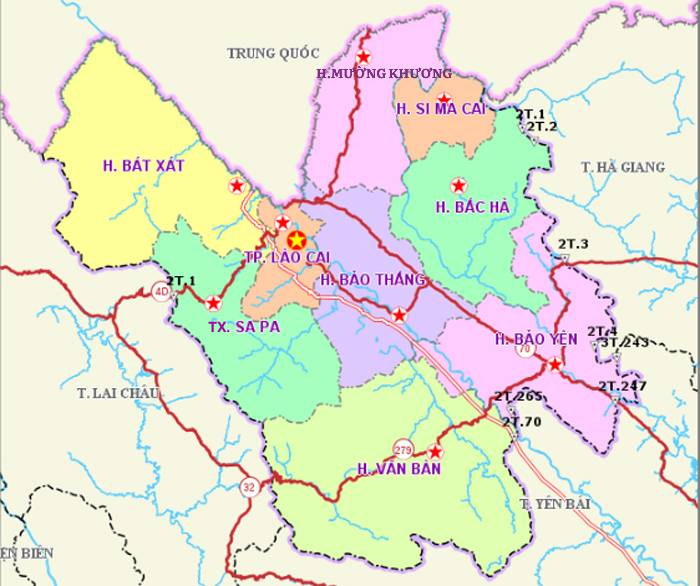
Mr. Bui Quang Vinh: Right! This limitation was quickly recognized by the Standing Provincial Party Committee. Lao Cai town (now Lao Cai city) has a narrow space, but it has commercial advantages, whereas Cam Duong town and the interval between the two towns are very flat, with a beautiful geographical location. empty. So, in the Standing Provincial Party Committee, I proposed combining Lao Cai and Cam Duong towns into one. The second is to construct a new administrative area in the middle, back and forth 10 kilometers, to ensure national defense and security, as well as to cede the entire old Lao Cai town area to build a border gate economic zone.
Many people are wondering why a province that has only been reestablished for ten years has moved its capital, and some opinions differ, wondering where the resources are to do so when there are so many problems to solve, if making an urban area. The new town requires a large sum of money, and there are still many difficulties in the province's conditions…
Reporter: So at that time, how did the province get resources to implement?

Mr. Bui Quang Vinh.
Mr. Bui Quang Vinh: This is also a problem when there are a lot of skeptics present, but the provincial leaders still decided to "relocate the capital" and offer a lot of creative solutions to implement. I just gave one example: when building the main road, Tran Hung Dao Boulevard, I and the Director of the Department of Transport went to the Ministry of Transport to present the urgency of the road and to request that National Highway 4E be moved into the 58 m road.
National highways passing through the center of the provincial capital must be expanded in accordance with regulations. The province agrees to carry out the entire site clearance, land filling, road leveling, and the rest of the road surface such as asphalt mats, technical infrastructure system, and so on. As a result, Lao Cai city now has a large and beautiful road.
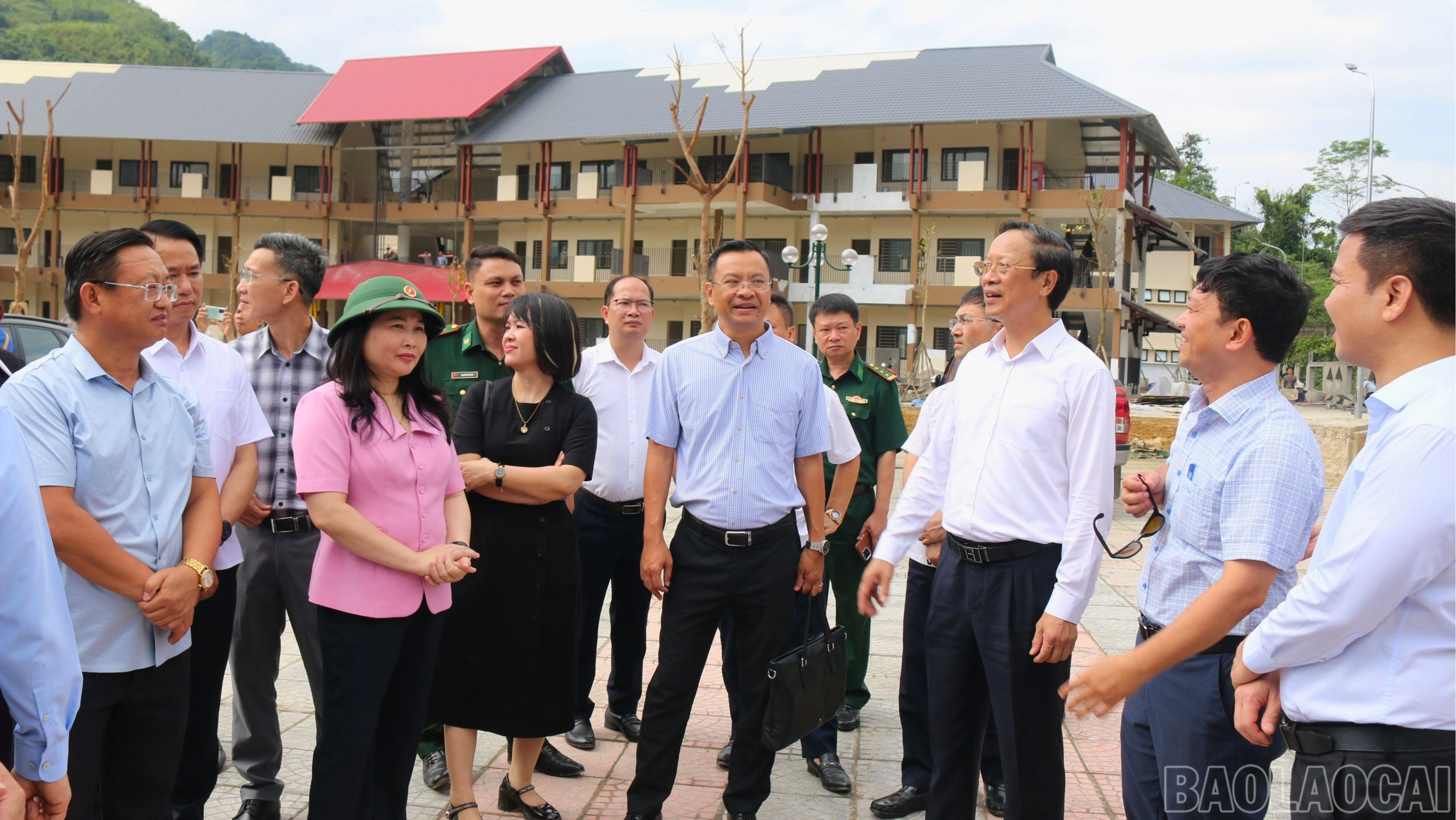
Provincial agencies began to relocate to the Lao Cai - Cam Duong New Urban Area in 2007. The new urban area is not only large, but it is also regarded as very beautiful by the Vietnam Association of Architects due to the preservation of hundreds of hectares of green forests, as well as the attempt to locate the headquarters on high hills to limit leveling... Move the capital., I believe it is a very reasonable vision, and the planning thinking is also very advanced, as it is still promoting today.
Reporter: In this 10-year period (2001 - 2010), Lao Cai is also very famous for not asking for money but asking for a mechanism to have better conditions for local development? This is one of the great creations of Lao Cai?
Mr. Bui Quang Vinh: The state budget was very limited between 2001 and 2005, but every province asked for it, so even if Lao Cai province asked for it, it didn't have it. The mechanism is the most important; there is a mechanism that will make money; all that is required is to think of a mechanism. The 58 m road project, for example, is a typical example of Lao Cai's application for a mechanism. Alternatively, as the border gate economy develops, the investment must meet the requirements of large yards and inspection. Import and export activities through the border gate benefit the entire country, so the province has asked the Central Government to allow localities to keep 50% of the excess revenue collected from the border gate according to the Ministry of Finance's plan. That proposal was approved by the Prime Minister, and since then, Lao Cai has invested a few hundred billion more in infrastructure construction each year. That money is also very valuable in the conditions of a poor province like Lao Cai, which are examples of applying for the mechanism.
Furthermore, there are numerous other mechanisms and policies in the field of agriculture and forest preservation; if the mechanism increases, the locality will benefit, or some businesses generate revenue in the area, the province has agreed with the General Department of Taxation to divide and pay taxes fairly. All of these methods demonstrate Lao Cai's inventiveness. The provincial leaders must "scratch their heads" to figure out how to get resources, save money, and build Lao Cai so that it can develop.
Reporter: Sincerely thank you!
According to Thanh Phu/LCDT