Old Marks of Lao Nhai
Many people in Lao Cai city remember Lao Nhai as a familiar sight, filled with old legends that bear the city's historical and cultural mark.Nowadays, when walking on Phan Boi Chau Street or Nguyen Hue Street, in Lao Cai Ward, Lao Cai City, few people know that hundreds of years ago, this place used to be a riverside market, with boats on the wharf and under the boat - a bustling trading place between Vietnam and China.

Nguyen Hue Street leading to Lao Cai International Border Gate is part of the old Lao Nhai market street.
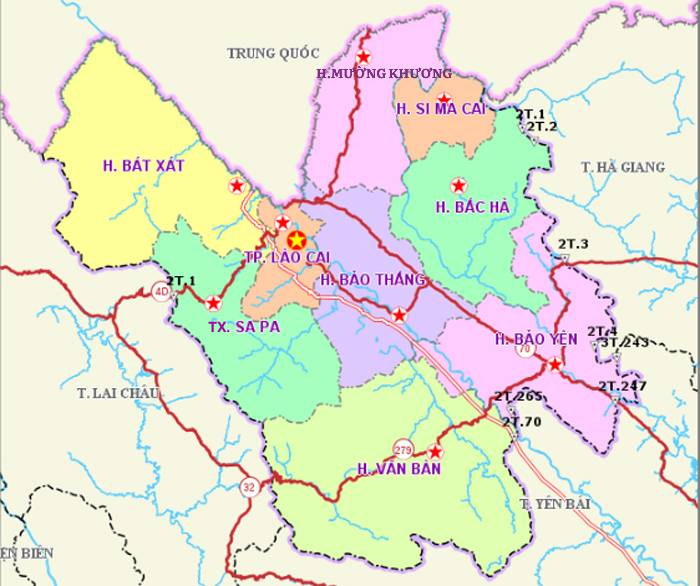
Lao Nhai Market Street is located near the junction of the Red and Nam Thi rivers. According to the book "Names of Vietnamese Villages," written between 1810 and 1813 under the reign of Gia Long (Nguyen Dynasty), the ancient urban area of Lao Nhai belonged to Bao Thang camp, known as "Bao Thang quan," which included the entire land of Lao Cai ward today. Nguyen Hue street runs from the Coc Leu bridge to the border gate and serves as the heart of Lao Nhai's ancient town. The current name Lao Cai is most likely a mistake for Lao Nhai, and the city was likewise created from that historic market street.

One corner of Pho Moi is the former Tan Nhai area, now in Lao Cai ward, Lao Cai city.
During the Nguyen Dynasty, this historic urban area was enlarged down to the Red River bank, dubbed Tan Nhai (New Town), and on the other side of the Red River, where there are many cotton trees, known as Coc Leu. At the same time, near to the historic town of Lao Nhai and the Nam Thi River, there is a small street called Pho Teo, directly at the foot of Hoa Hieu hill - a spot that commemorates the Tran Dynasty monarchs' and mandarins' work in protecting the border.

Old Teo Street (Photo: Early 20th century documents).


The old Teo Street was renamed Phan Boi Chau City.
According to one account, Pho Teo was a small street that served as a housing location for tradespeople, primarily horse herders. When Chinese merchants needed to rent horses or hire porters, they would come here and call it "Xiao zhen" - which means tiny street. Pho Lao Nhai, with its humble dwellings and lively stores, was a popular destination for traders from all around.
Another explanation is that when the French colonists invaded Lao Cai in 1886, they began to restore order in the Bao Thang Quan area. Finding the name "Xiao zhen" difficult to pronounce, the French changed it to "Pho Teo". From then on, the name Pho Teo became popular and was used by people in the area.
The name Pho Teo is also thought to have originated when the French began construction of the Viet-Dien railway (Hanoi-Kunming) in 1898. When this railway opened, the horse-drawn carriage company disbanded, leaving the neighborhood abandoned, with only a few rows of decaying dwellings along the river.

Trade between border residents of Lao Cai (Vietnam) and Yunnan (China) at Lao Cai border gate in the early 20th century (Photo: Document).

Lao Nhai, a trade bridge, is now an international border gate.
Lao Nhai is not only a well-known trading bridge, but also a remnant of the Red River culture from the country's inception. Archaeological relics discovered in the Lao Cai town region, like as bronze plowshares, axes, and drums, demonstrate that an ancient population lived here approximately 3,000 years ago. With a good location at the junction of three rivers at the start of the Christian period, Lao Nhai quickly developed into an urban region and became a major economic and cultural center along the banks of the Coi River (red river).

Ho Kieu Bridge when it was first built in the early 20th century (Photo: Document).
During the Hung Kings' reign, Lao Cai belonged to the Tan Hung tribe. During the Au Lac period, this territory belonged to the Tay Vu tribe. When our country earned independence in 938 through the triumph of Bach Dang, the Ly Dynasty's Chau Dang controlled the Lao Cai urban region. This location was revered and an important part of the country's administrative structure throughout numerous dynasties, including the Tran, Le, and Nguyen. In 1907, French colonialists formed Lao Cai province, which includes Lao Cai town and nearby territories. The province covers 5,177 km² and has 15 ethnic groups and 60,000 people.


The ancient citadel wall of Liu Yongfu in the Mau Temple area, Lao Cai ward, Lao Cai city.
When Lao Cai province was liberated from the Kuomintang in November 1946, the authorities organized it into eight administrative entities. Lao Cai town was divided into three areas: Lao Cai, Coc Leu, and Pho Moi. After the peace was restored, Lao Cai town was extended and divided into several districts. The name Lao Nhai has changed and merged several times throughout history, yet it has retained its unique cultural and historical values.

The international railway runs through Lao Cai ward.
Lao Nhai used to be a part of Lao Cai city, and it still maintains its thriving trading relationship with China from centuries ago. Lao Cai City, the only central metropolitan area in the country's border province, has an international border gate and an international railway, and serves as the gateway between ASEAN countries and China's large Southwest region.
During General Secretary and President To Lam's State visit to China from August 18 to 20, 2024, the Socialist Republic of Vietnam and the People's Republic of China agreed in a joint statement to provide and support Vietnam in the development of a feasibility study report for the Lao Cai - Hanoi - Hai Phong standard gauge railway (1,435 mm). When the railway line is expanded and transport capacity is enhanced, as well as the Sa Pa Airport project begins construction and goes into service, Lao Cai's gateway position will be strengthened even further.
Teo Street has now been renamed Phan Boi Chau City, with large and beautiful houses built close together, but in the memories of many Lao Cai people, the image of a small, beloved riverside street, with the many difficulties of the early days of re-establishment, is still preserved.

Lao Cai City is an important gateway connecting ASEAN countries with the vast southwestern region of China.
From Lao Nhai to Lao Cai, from a small town to Lao Cai city is a long journey with many ups and downs of history. Today, Lao Cai city - where the Red River flows into the heart of Vietnam on both banks - is truly beautiful and modern. The administrative boundaries have also expanded many times with 17 communes and wards, taking the Red River as the axis of symmetry, becoming the political and economic center of the province. But the mark of the old Lao Nhai is still present through stories, historical relics and indigenous cultural values.

Lao Cai city today is as beautiful as a silk strip, formed and developed following the ancient Lao Nhai market town (Photo: Ngoc Bang).
The Old Marks of Lao Nhai is not only a story about a land, but also a story about people, about historical and cultural values that have been preserved for hundreds of years. Lao Nhai, with all the ups and downs of history, has always been an important part of Lao Cai, a place that preserves the memories and traditions of a rich and proud land.
https://baolaocai.vn/dau-xua-lao-nhai-post389481.html