Lao Cai recognized 2 more national intangible cultural heritages
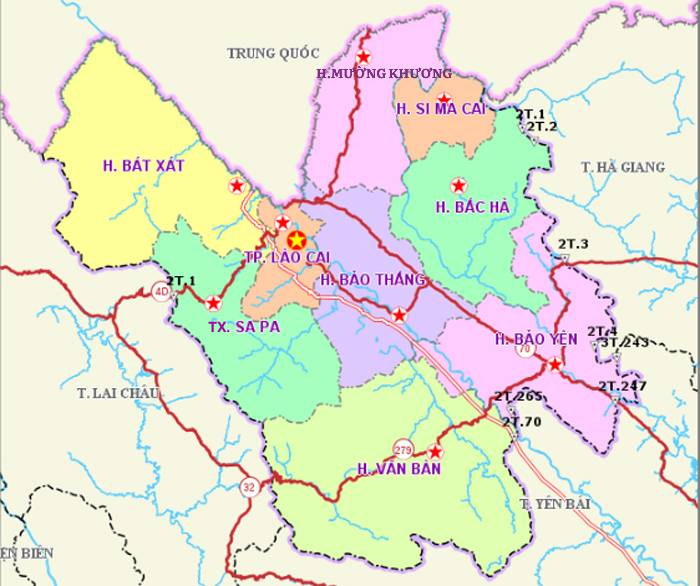
Two national intangible cultural heritages were recognized: the weaving craft of the Tay people in Nghia Do commune, Bao Yen district and the forest worship ritual of the Pa Di people in Muong Khuong district.
Wicker products of Tay women in Nghia Do. Photo TL.
Weaving profession of Tay people in Nghia Do commune
Weaving has long been a traditional craft of the Tay people in Nghia Do, Bao Yen. From natural materials and the skillful hands of women, many necessary products have been created for decoration and daily life of the Tay people here.
Traditional weaving has created many products used in people's daily life and is considered a unique cultural feature imbued with national identity. Tay people often choose weaving items for use in decoration, daily life, production and creating products for tourism in order to preserve and promote the traditional handicraft of their people.
The wickerwork products of the Tay women, the ingenuity and sophistication are shown through the patterns combined between black and white bamboo, diverse and eye-catching motifs from simple trays or "lips", "deng hoa"... The main decorative patterns are often in the shape of "beo phay" flowers, a type of flower that blooms in the forest with white pistils, the part near the base is often woven in the shape of diamond seeds and "mac cuong" flowers.
Traditional weaving products in Nghia Do are quite unique and have become items used by locals to decorate their homes and at homestays to serve the needs of tourists.
Forest worship ritual of Pa Di people, Muong Khuong district
Like other ethnic minorities living in the highlands, the Pa Di people in Muong Khuong district, Lao Cai province also keep a forbidden forest for themselves, which they call a sacred forest. The sacred forest is very important to the Pa Di community, because they believe that the forest god, tree god, and stream god are gods who help drive away wild animals, provide wood for building houses, provide drinking water, etc. Therefore, they sanctify the forest with the voluntary consciousness of protecting the gods that support their village. They protect the forest as if it were their own home, never daring to cut down trees or break even a single branch. Since they were children, the Pa Di people have been taught and educated by their grandparents and parents about their ethnic customs regarding their responsibilities and duties towards the sacred forest of the village.
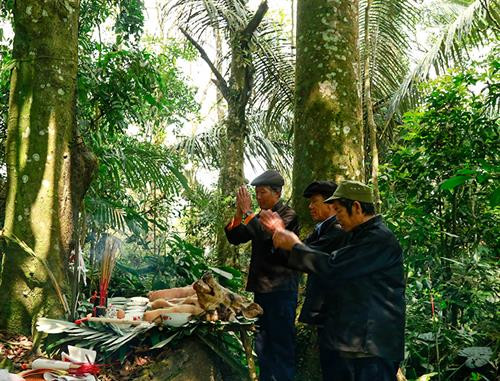
The shaman prays to the gods to bless the villagers with good things. Photo TL.
For the people in the highlands, their lives are closely linked to the mountains and forests, so the forests are very important to them. Today, the same is true for the forests that need to be protected, especially the upstream forests, the forests that protect the safety of the villages.
The sacred forest in the village will be assigned to one or two managers in charge of handling all activities related to the community and spiritual rituals in a year, the most important of which is the forest worship ceremony. No one knows when and where the forest worship ceremony began, but it is an important ceremony that has been passed down for thousands of years. The Pa Di people in Sa Pa village, Muong Khuong town, Muong Khuong district, often hold a forest worship ceremony at the end of the first lunar month every year, in the village's forbidden forest with offerings of products grown by the villagers themselves.
The announcement of two more national intangible cultural heritages will contribute to facilitating the work of preserving, maintaining and promoting the unique cultural heritage of ethnic minority communities in Lao Cai./.