Lao Cai – From the center of ancient Vietnamese settlement to the center of international trade connection
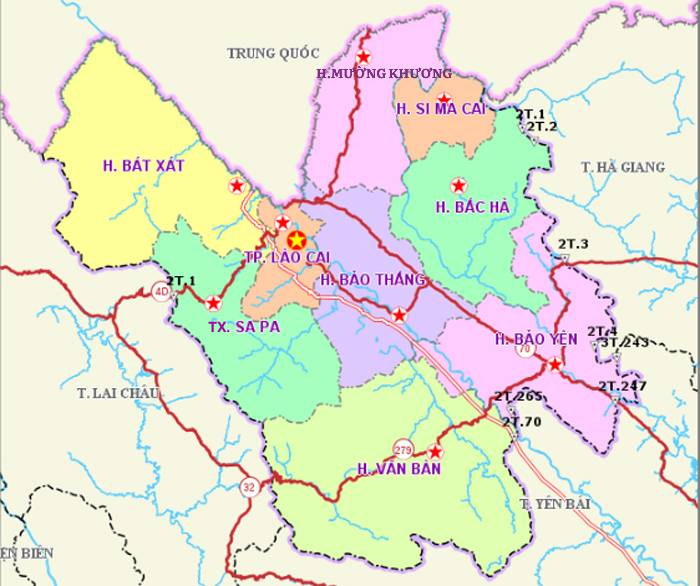
On December 20, 2024, the Government issued a Plan to develop Lao Cai into a center for connecting economic trade between Vietnam and ASEAN countries with the Southwest region of China. In which, Lao Cai city is the center of that connection journey. Looking back at the long history of this borderland, we can see that in historical periods, Lao Cai has always been a center, a connection and diffusion point.
Residential center of ancient Vietnamese people
During archaeological excavations in the 70s and 80s of the 20th century, archaeologists continuously discovered paleolithic relics in Cau Den, Cong Nghiep hill and Vi Kim area including: pointed tools, horizontal and vertical axe tools, some tools similar to large hand axes. Through research, archaeologists unanimously affirmed that the artifacts belonged to the Son Vi culture. Son Vi residents in the ancient Lao Cai city area lived mainly by hunting, gathering and trading with residents on the other side of the border. Archaeological discoveries in the 90s of the 20th century and the early years of the 21st century determined that the artifacts found in the Lao Cai city area belonged to the Dong Son culture. From the 7th century BC, the ancient Vietnamese in Lao Cai began to move from prehistoric to early historical times, with a state (Van Lang) whose foundation was the Dong Son culture. Entering this era, Lao Cai residents have made many contributions to creating a developed agricultural civilization, casting bronze and smelting iron skillfully with dozens of bronze drums and dozens of other types of bronze objects. The diversity and richness of artifacts have shown that this place was also a major metal center of ancient times. From archaeological discoveries, combined with research on ancient documents, scientists unanimously affirm that in the area of Lao Cai city today, in the past, it was the center of a large tribe with the continuous presence of cultural layers.
In addition, archaeological artifacts discovered during this period also initially demonstrated economic and cultural exchanges between Lao Cai and the Yunnan region (China). In 2005, Dong Son artifacts in a tomb discovered in Kim Tan ward (Lao Cai city) were identified as having some characteristics of Han culture. At the same time, many conch shells originating from the Gulf of Tonkin were present in Yunnan during this period. This shows that, with its position as a border gateway and the Red River's lifeline, Lao Cai has become a center of economic and cultural exchanges in the region. Lao Cai is a center for transporting copper ore from the upper reaches of Lao Cai and Yunnan (China) down to the Northern Delta, as well as transporting marine products (conch shells, salt) and agricultural products from the fertile plains of Northern Vietnam to Lao Cai and Yunnan.

River junction in the early 20th century (documentary photo)
Old Street
Written documents about Lao Cai border gate area appeared from the Nguyen Dynasty with the records of Nguyen Dynasty historians. Dai Nam Nhat Thong Chi of the National History Institute of the Nguyen Dynasty mentioned "Bao Thang gate is located in Son Yen commune, Thuy Vi district, where the two streams of Thao and Ngan rivers converge, near Bao Thang town, adjacent to Ha Khau gate of Thanh country". The book Hung Hoa Ky Luoc compiled by Pham Than Duat in 1856 confirmed that Thuy Vi district had 08 caves, 01 street, 01 fishing village. One street here is Bao Thang street. Dong Khanh Dia Du Chi wrote that during this period there were 2 streets: Minh Huong street (Chinese street) and Bao Thang street (Kinh street).
It can be seen that in all records about Lao Cai border gate area, the name "Pho" appears. In Mandarin, it is called Lao Nhai. On February 22, 1902, the French chose to build this area into the central quarter of the Military Region 4, then the provincial capital of Lao Kay. In 1907, Lao Kay civil province was established with the center being the urban area that had been established since 1902. In the central urban area, there were enough railway, road and waterway systems. Creating a vibrant border space.

The international border gate pair of Lao Cai (Vietnam) - Hekou (China). Illustration photo: Ngoc Bang
Border City
On the foundation of that old town, Lao Cai town was established after Lao Cai province was liberated and became the provincial town of Lao Cai province until 1975. After the merger of the three provinces of Lao Cai, Yen Bai, Nghia Lo into Hoang Lien Son province, from 1976 to early 1979, the provincial center was located in Lao Cai town. In 1991, Lao Cai province was re-established, on September 1, 1992, Lao Cai town was re-established as the provincial town of Lao Cai province. In response to the need to expand the provincial center space, to meet the development of Lao Cai province in general, in 2004, Lao Cai city was established on the basis of merging Lao Cai town and Cam Duong town. The old town area is planned to become a border gate economic zone and is the area that creates momentum for the development of the Lao Cai - Hanoi - Hai Phong economic corridor. The development of the border economic zone has created the dynamism of a border city, continuing the bustling trading space in history. Ho Kieu II Bridge was established for pedestrians, the old Ho Kieu Bridge was for railway activities. The new Kim Thanh Bridge was built, the international road border gate No. II was established to meet the import and export needs between the two countries and countries in the region. Lao Cai City is the only city in the country with a pair of international road border gates with the People's Republic of China. In the border economic zone, a spiritual tourism area has been formed with two key relics of the city: the national historical and cultural relic of Thuong Temple and the provincial historical relic of Mau Temple. The relics belong to the Mother Goddess worship and the belief in Duc Thanh Tran - the endogenous, traditional beliefs of the Vietnamese people, as cultural milestones at the border.
From a large primitive settlement, a strong metal center in the Dong Son period, an old town in the Nguyen period, a provincial capital during the French colonial period to a border city, throughout its history, Lao Cai city has always been associated with the streets, with its hustle and bustle, and is the center of exchange, convergence, connection and spread./.