Ivory white Tra Chau silk thread
Although the traditional cultural identity of many ethnic minorities is at risk of being lost, the Dao community in Tra Chau village, Son Ha commune, Bao Thang district still preserves and conserves the values of traditional weaving.
Weaving in Tra Chau village has been passed down from generation to generation by local women.
With the cultural staff of Son Ha commune, we followed the concrete road winding through the vast green cinnamon forests to the center of Tra Chau village.

Mr. Ban Van Quang is knowledgeable about the traditional culture of the Dao people, including weaving.
To learn more about the Dao people's ancient weaving trade, we paid a visit to the family of Mr. Ban Van Quang, a Dao ethnic culture researcher. Mr. Quang is also a Dao son who was born and reared in Tra Chau village. Mr. Quang, 66 years old and a retired cadre, has held the following positions: Chairman of the People's Committee, Chairman of the People's Council, and Secretary of the Party Committee of Son Ha commune.

The fabric still hangs white as ivory every day on the loom.
When we arrived at his house, Mr. Quang was busy organizing, drying, and copying antique literature. Mr. Quang still had a few dozen ancient volumes written in Han script. However, a few were damaged by the flood and the ink was smudged, forcing Mr. Quang to recopy them. Mr. Quang learned Han script and was introduced to Dao culture when he was a teenager. He didn't have much time to study and practice calligraphy during his working life, so when he retired six years ago, he dedicated his entire life to conserving and duplicating historic texts.
Despite his busy schedule, Mr. Quang made the time to explain the weaving profession of the Dao people in Bao Thang, particularly the residents of Tra Chau village. Mr. Quang stated that the Dao people, wherever they live, are always concerned with preserving their cultural identity, customs, living habits, traditional clothing, and weaving.

Thread problem.

Each thread is a connection between the past and the present, between conservation and development, between stillness and movement.
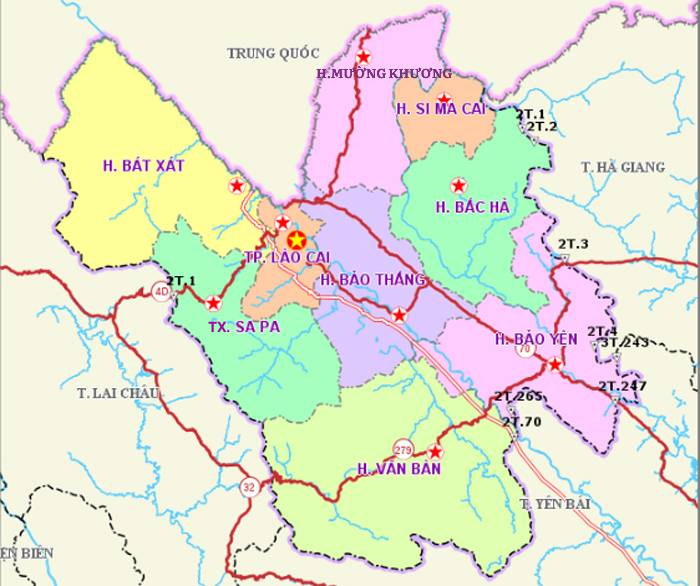
Mr. Quang went on to say that Dao people make up 34.7% of families in Bao Thang district (equal to 39 thousand people), with the majority residing in Phu Nhuan commune, Son Ha commune, Tang Loong town, and Pho Lu town. Among them, the Dao people of Tra Chau still practice the traditional weaving craft the best. The community currently contains approximately 50 sets of weaving looms.

Weaving is a part of the culture of the Dao people that they have preserved.
Following Mr. Quang's introduction, we went to the neighbor's house to meet Mrs. Dang Thi Khoa, 52, one of Tra Chau's excellent weavers. Mrs. Khoa set the loom next to the window, which is the best location for weaving with natural light. Mrs. Khoa was weaving a roll of fabric on her loom. The ivory-white threads hung like thin vapor with each quick swing. The clattering, creaking sounds of wood clashing and rubbing against one another made the primitive cottage in the heart of the cinnamon grove more lively.

Materials for a weaving session.
Mrs. Khoa's loom has been in operation for decades, yet it is still very old compared to the spinning frame. Mrs. Khoa became the fourth generation owner of the ebony-colored spinning frame. Mrs. Khoa regards the spinning frame as a "treasure" of the family and holds generational importance. Mrs. Khoa stated that the Dao people in Tra Chau used to grow cotton, spin it, and spin yarn, but now the yarn is sold at a low price at the district market, thus cotton plants are no longer grown in Tra Chau fields.

In Tra Trau, women of adulthood must know how to spin and weave.
To get the fabric woven by loom, it must go through many elaborate and meticulous stages such as boiling the yarn, starching the yarn, twisting, pulling, and spinning the yarn. Each stage, associated with diligence and discipline, in the Dao people's concept, has different taboos and prohibitions. For example, washing hands three times before working, not telling sad stories, not scolding or speaking harshly to anyone near you while weaving...
For Dao women, in addition to their daily clothes, Dao girls of marriageable age must know how to weave, sew, and embroider at least two new sets of clothes to wear on their wedding day. Families with good economic conditions can sew and buy four new traditional costumes for themselves, and when performing the ancestral worship ceremony, they will change into two other sets.

The thread of cloth hangs from the loom by the window.
Like other households in the village, Mrs. Khoa’s family’s traditional weaving is partly to serve their own needs, and partly to produce goods for sale to those in need. Nowadays, the people’s concept has also changed. In the past, Dao women had to know how to spin silk, weave, and embroider, but now in some places, women buy ready-made fabric from people like Mrs. Khoa and then dye it indigo, embroider patterns, and cut and sew clothes themselves. These changes are not enough to eliminate the creaking sound coming from the looms in Tra Chau day and night; beside the window, the ivory-white fabric threads still hang like thin curtains.


Tra Trau people grow herbs as raw materials for indigo dyeing on brocade fabrics.
Two years ago, the Ministry of Culture, Sports and Tourism issued Decision 783/QD-BVHTTDL recognizing the weaving craft of the Dao ethnic group in Bao Thang district as a national intangible cultural heritage. For 114 Dao households in Tra Chau, this is a source of great pride, because the traditional cultural identity will be preserved, conserved and effectively promoted in daily life, including the weaving craft.
https://baolaocai.vn/trang-nga-soi-to-tra-chau-post391778.html